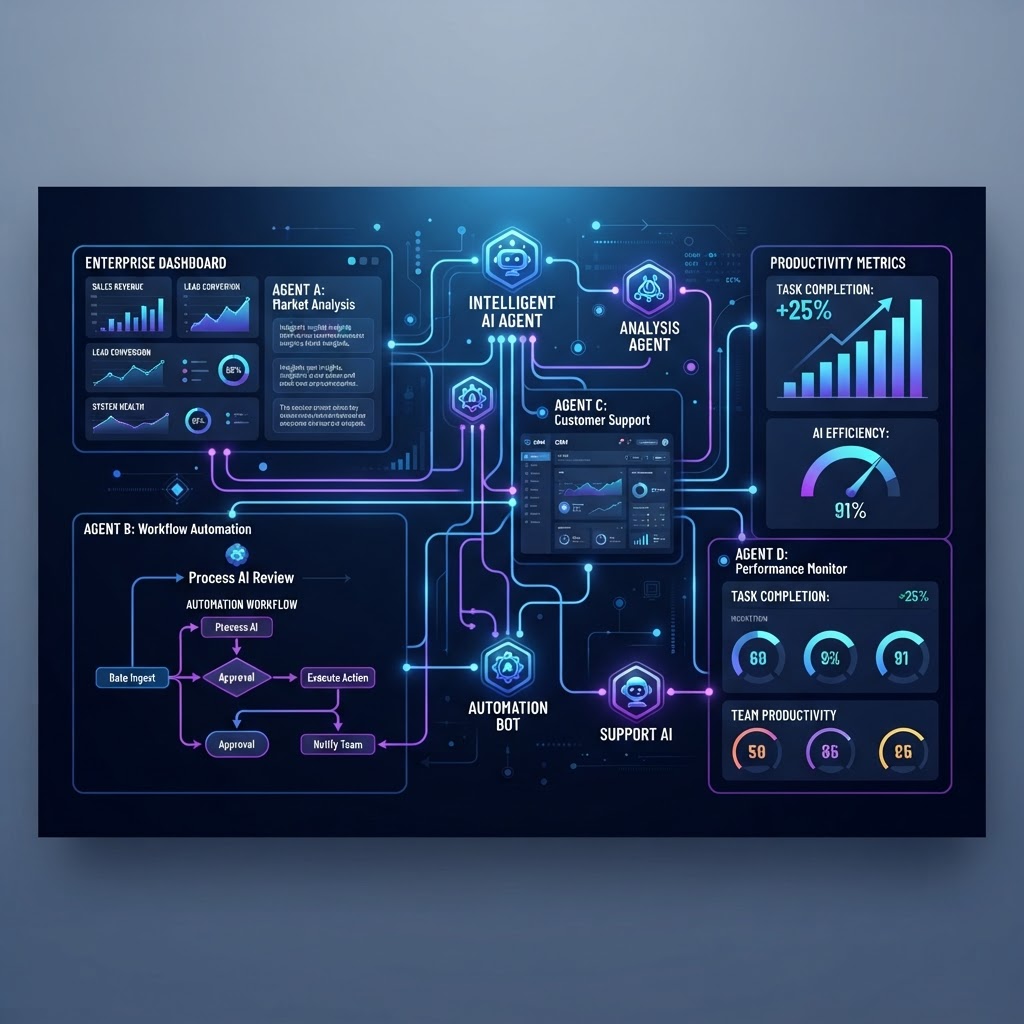
A Prediction That Became Reality
In late 2025, Gartner made a prediction that seemed ambitious: 40% of enterprise applications would feature task-specific AI agents by 2026, up from less than 5% in 2025. As we close out 2026's third quarter, the numbers are tracking right on schedule.
What Changed So Quickly?
Three forces converged to make this happen faster than anyone expected:
1. AI Agent Frameworks Matured
Tools like AutoGen, CrewAI, and LangGraph moved from experimental to production-ready. Developers can now build reliable multi-agent systems in days, not months.
2. Cost Plummets
Running an AI agent costs a fraction of what it did in 2025. With models like LLaMA 3.3 and Gemini 2.0 Flash, a single agent can handle thousands of customer interactions for under $10/month.
3. Enterprise Demand Exploded
A Gartner Q1 2026 survey found that 80% of enterprises now have at least one production application with an embedded AI agent — up from 33% just a year prior.
What This Means for Small and Medium Businesses
You don't need to be a Fortune 500 company to benefit. Here's what AI agents are doing for businesses right now:
- **Customer Support Agents** — Handle 70% of inquiries automatically, escalating only complex cases to humans
- **Sales Agents** — Qualify leads, schedule meetings, and send follow-ups 24/7
- **Operations Agents** — Monitor inventory, predict stockouts, and auto-reorder
- **Finance Agents** — Track expenses, flag anomalies, and generate reports
The Risk of Waiting
Here's the uncomfortable truth: businesses without AI agents by end of 2026 will face a competitive disadvantage that compounds over time. It's not about being cutting-edge — it's about baseline efficiency.
A competitor using AI agents for customer support responds in seconds, not hours. They process orders automatically. They never miss a follow-up. How do you compete with that manually?
How to Start (Without Breaking the Bank)
You don't need a massive AI transformation initiative. Start with one workflow:
1. Identify a repetitive task — What does your team do over and over that follows predictable rules?
2. Map the process — Write down each step, decision point, and exception
3. Build or buy — Use a platform that lets you describe the workflow in plain English and generates the agent automatically
4. Measure — Track time saved, errors reduced, and customer satisfaction
The EROGIAN Approach
At EROGIAN, we help businesses deploy their first AI agent within 48 hours. Not a chatbot that just answers FAQs — an agent that actually does work: booking appointments, following up with leads, generating quotes, and updating your CRM.
The Bottom Line
Gartner's prediction wasn't just a forecast — it was a warning. The 40% threshold means AI agents are now standard infrastructure, not experimental technology. The question isn't if you'll adopt them, but how much market share you'll lose before you do.