The Quiet Revolution
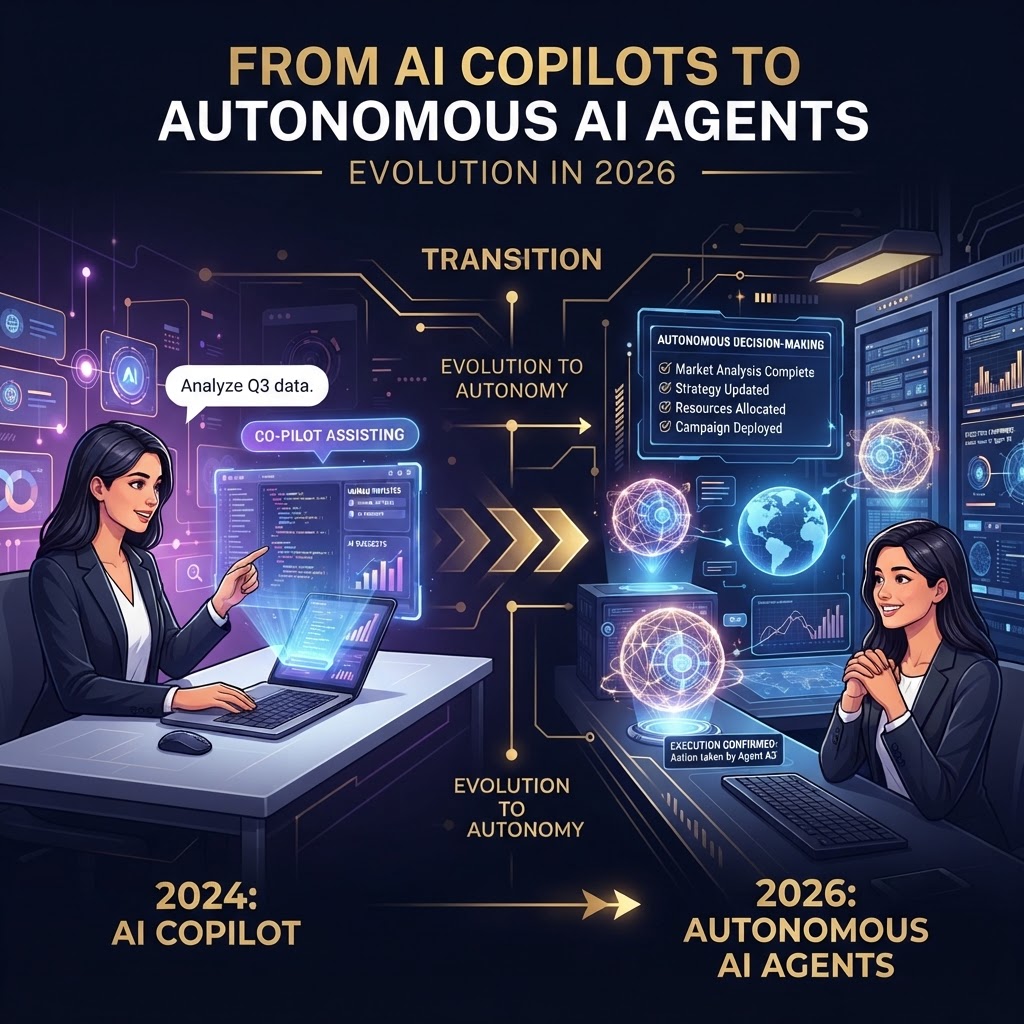
In 2024, the buzzword was 'copilot' — AI that helps you write code, draft emails, and generate ideas. You were still the pilot. AI was the assistant.
In 2026, the conversation has fundamentally shifted. AI is no longer just helping — it's doing. Autonomous AI agents can now execute complete workflows, make decisions, and learn from results without human intervention at each step.
What's Different About Autonomous Agents?
A copilot waits for your instructions. An autonomous agent operates with goals.
Copilot model:
- You ask: 'Write a follow-up email to this lead'
- AI generates the email
- You review, edit, and send
Autonomous agent model:
- You set a goal: 'Follow up with all leads within 24 hours and book meetings'
- The agent monitors new leads, crafts personalized follow-ups, sends them, tracks responses, and schedules meetings — all without your involvement
This is a massive difference in capability and impact.
The Three Stages of AI Autonomy
Stage 1: Reactive (2023-2024)
AI responds to direct prompts. No initiative, no memory, no learning. ChatGPT's original form.
Stage 2: Assisted (2024-2025)
AI suggests actions and helps execute them. Copilots, code assistants, writing aids. Human is still in the loop for every decision.
Stage 3: Autonomous (2026-present)
AI agents operate independently within defined boundaries. They monitor, decide, act, and report. Humans set policies and review outcomes, not individual actions.
Real-World Examples Happening Now
Customer Support:
An autonomous agent at a Nigerian fintech company now handles 85% of customer tickets. It reads the issue, accesses the customer's account, resolves the problem, and only escalates to humans when it detects emotional distress or complex financial disputes.
Sales Pipeline:
A Lagos real estate agency deployed an agent that monitors property inquiries, qualifies leads based on budget and timeline, sends personalized property recommendations, and books viewing appointments directly into agents' calendars.
Content Marketing:
This blog you're reading? The research, drafting, and publishing process can be fully automated. An agent monitors trending topics, writes articles, generates images, and publishes — with a human editor reviewing before it goes live.
The Fear vs. The Reality
Many business owners worry about losing control. But autonomous agents aren't rogue AI — they operate within strict guardrails:
- **Defined permissions** — Agents can only access what you explicitly allow
- **Audit trails** — Every action is logged and reviewable
- **Escalation rules** — Agents must escalate when confidence drops below a threshold
- **Human overrides** — You can always step in and take control
How to Introduce Autonomy in Your Business
Don't start with a fully autonomous system. Build trust gradually:
1. Automate one repetitive task — Start with something low-risk like sending reminder emails
2. Review the agent's work for 2 weeks — Check every action before it executes
3. Gradually reduce oversight — As confidence builds, let the agent act independently
4. Expand to new workflows — Once the first agent is trusted, add more
The Cost of Inaction
Every day you're manually doing what an agent could handle automatically, you're paying for it in time, errors, and missed opportunities. A business running 5 autonomous agents is competing against your manual processes the way a calculator competes against long division.
The Bottom Line
The shift from copilots to autonomous agents isn't a future prediction — it's happening right now. Businesses that learn to deploy and manage autonomous agents will operate at 5-10x the efficiency of those that don't. The question isn't whether to adopt, but which workflow to automate first.